Halloween Happenings
(Or Who Is This Sam Hain Bloke, Anyway?)
Do you love Halloween and look forward to carving pumpkins, stuffing yourself with chocolate eyeballs, ghost stories and scary movie fests? I do, though my pumpkin carving skills are somewhat lacking! For many people, Halloween is a fun celebration of all things spooky. For others, it’s just commercialised clap trap that’s come over from America to make us spend more money. If you’re one of those you might be surprised to discover the true origins of this autumnal celebration.
So, where did Halloween actually come from — and how did it evolve into the behemoth it is today?

Pagan Past
Far from being a modern American invention, Halloween can be traced back to the ancient Celtic festival of Samhain (pronounced SAH-win). For those whose knowledge of ancient history is as lacking as mine, the Celts lived across Britain, Ireland and parts of northern Europe. Their lives were closely tied to farming and the changing seasons, and Samhain marked the end of the harvest and the beginning of the dark winter months.
It was an important point in the Celtic year and seems to have been associated with fire, feasting and the supernatural. Later folklore tells of a time when the boundary between the human world and the spirit world became easier to cross, allowing ghosts and other beings to wander among the living. Food might be left out for them, while people disguised themselves in costumes — sometimes made from animal skins — either to avoid being recognised or to frighten unwanted spirits away.
Bonfires were also part of Samhain celebrations and were believed to offer protection as winter approached.
Ringing any bells yet?

Roman Influences
Fast forward a little to the Roman invasion in 43 AD. During their 400 year occupation and rule of Britain the Romans assimilated many of their own celebrations into existing Celtic festivals.
It’s a popular belief that, as the Romans brought the apple to Britain — the symbol of the goddess Pomona — this is where the Halloween tradition of bobbing for
apples originates. However, apples, nuts and divination games are also documented in later Irish Halloween tradition.
The Middle Ages & Christianity
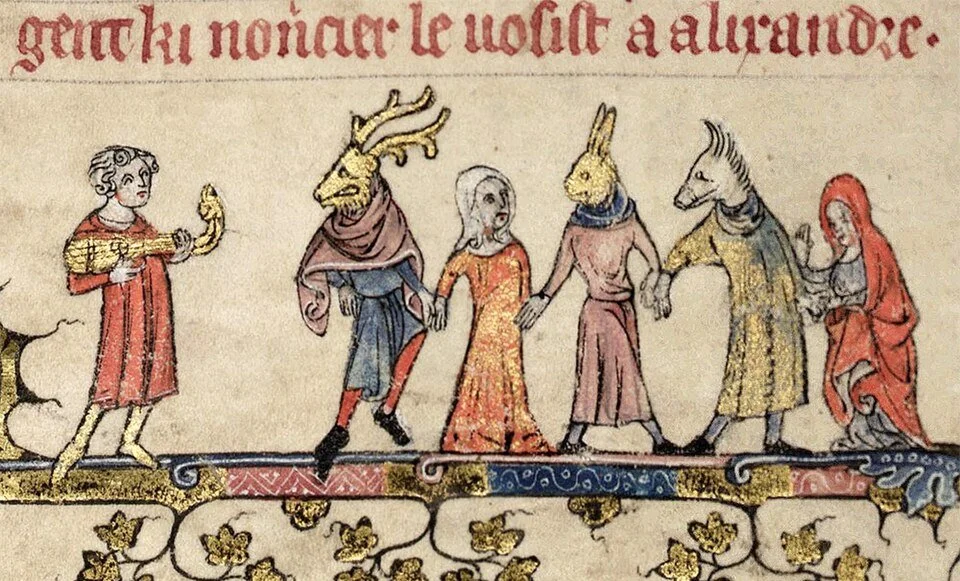
Fast forward again to the Middle Ages. Medieval folk began dressing as ghosts, demons and other malevolent creatures to protect themselves from evil spirits — much like the Celts in their animal skins. They would perform antics in exchange for food or drink. This custom was known as ‘mumming’.
Although mumming later became particularly associated with Christmas, similar traditions of dressing up and performing for food or drink were also part of Halloween customs.
By the 9th century, Christianity had spread through Celtic lands and gradually became entwined with many of the older seasonal traditions.

Samhain Becomes Halloween
One of these was the Christian festival of All Hallows’ Day or All Saints Day which became established on 1st November, with All Souls’ Day following on 2nd November.
As Samhain was celebrated on 31st October, the day before All Hallows’ Day, it naturally became All Hallows Even - later Hallowe’en then Halloween.
Here we see the early roots of trick or treating. Poor people would visit the homes of wealthier families and promise to pray for their dead relatives in exchange for pastries known as ‘soul cakes’. Later, this practice — known as ‘souling’ — was taken up by children, who would go from door to door asking for gifts. In Scotland and Ireland, young people took part in a tradition called guising, dressing up in costume and performing a song, poem, joke or other ‘trick’ before receiving fruit, nuts or coins.

By the 19th century, Irish and Scottish immigrants had carried many of these traditions to North America.
Yes, we gave it to them!
It’s unclear exactly where or when the phrase ‘trick or treat’ was first coined, but it was firmly established in American culture by the early 20th century.
The tradition of carving faces into lanterns also travelled across the Atlantic. In Ireland and Scotland, turnips and other root vegetables were hollowed out and carved,
often to frighten away evil spirits.
In America, the much larger and easier-to-carve (unless you’re me) pumpkin quickly took over — and the Jack O’Lantern as we know it was born.
Modern Halloween
I think it’s fairly safe to say that it took our American cousins to grab Halloween by the throat and commercialise the Hell out of it. When I was a child the big thing before Christmas was Guy Fawkes night and, though Halloween was noted, it wasn’t the big event it’s become in the last couple of decades. These days the shops are as full of Halloween themed decorations and food as they are for Christmas. Trick or treating and parties are now the norm rather than the exception. You can even get costumes for your pets.
Halloween attractions and scare events have become big business in the UK too. If you’re in striking distance of Crawley, West Sussex, I can highly recommend Shocktoberfest!
If you enjoy it like me you probably don’t see all this as such a bad thing although Scaramouche, the Truffle Witch cat, refuses point blank to wear a costume of any kind!

A Hauntingly Happy Halloween!
As we’ve seen, our ancestors believed that 31st October is when the veil between the world of the living and the world of the dead is at its thinnest. Over the centuries, all sorts of folklore became tangled up with Halloween.
It’s believed to be the best time to make contact with the spirits - if you’re brave enough to try. Be sure to
disguise yourselves so the fairies don’t recognise you and kidnap you! Carve your pumpkin lanterns to ward off evil spirits!
Or you could just snuggle up on the sofa with a scary movie and a mug of hot chocolate.
And if you don’t believe in any of that supernatural rubbish? Then remember that Halloween is also about celebrating the harvest and preparing and protecting ourselves for the long, dark winter months ahead.