
Saint Patrick’s Day
It’s Not Quite Irish!
Every year I hear people complaining about all the fuss over Halloween and saying that it’s an ‘American thing’, even though that’s not actually true. (See my Halloween blog for the real origins). Yet there’s one day that is widely celebrated in the UK that no one seems to question, even though many of the traditions we now associate with it actually developed in America.
Yes, it’s St Patrick’s Day.
There are lots of legends that we know, or think we know, about St Patrick. He was Irish, of course, he wore green, drove the snakes out of Ireland and he taught people about the Christian Holy Trinity using a shamrock as an illustration. Right? Um, no — all wrong!
If you were born and bred in Ireland, you probably know all this already (and maybe hate it). If not, here’s a little leprechaun sized blog on the legend and the truth about St Patrick and his day.

Irish Or American?
Although observed as a religious feast in Ireland for centuries, many of the traditions we now associate with St Patrick’s Day developed in America. As generations of Irish emigrants settled in America — particularly during the huge wave of migration in the nineteenth century — St Patrick’s Day became an increasingly important way of celebrating the culture they had left
behind. Like emigrants today, they celebrated their native culture whilst adopting new traditions, such as shamrocks, wearing the colour green and eating what came to be regarded as the national dish of corned beef and cabbage.
The first recorded St Patrick’s Day parade was actually held in 1601, in the Spanish colony of St Augustine in what is now Florida. Boston followed with an organised celebration in 1737. The first parade in Ireland didn’t take place until 1903 when the day became a public holiday. Today, around 100 St Patrick’s Day parades take place in the US. The largest is in New York City. It has 150,000 participants and nearly 3 million people line the parade route each year.
Many of the practices started in America have now been adopted by the Irish themselves but this is largely done for the benefit of tourists.
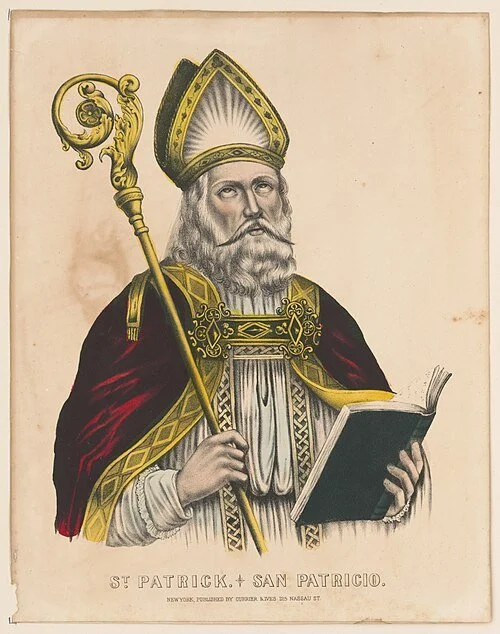
Who Was St Patrick?
St Patrick was born in Roman Britain in the late fourth century. He was captured by pirates at the age of 16 and taken to Ireland where he was sold as a slave . Six years later, he heard a voice telling him that he would soon go home and he managed to escape and return to his family. His time in captivity was important to Patrick’s spiritual development and a few years after returning home, he saw a vision that prompted him to return to Ireland as a Christian missionary.
Although often depicted holding a shamrock, there’s no evidence to suggest he ever used this plant to teach the Holy Trinity. He may have done but we don’t really know. As for ‘the wearing of the green’, green wasn’t traditionally associated with St Patrick at all. Blue was the colour linked with him; green became increasingly associated with Irish identity much later.

“I Hate Snakes!”
Not really, I rather like them. I’m just quoting Indiana Jones! But, back to St Patrick. Did he really drive all the snakes out of Ireland? I’m afraid not. There have never been snakes in post-glacial Ireland so there was nothing for him to banish!
As for corned beef and cabbage, it’s not the national dish of Ireland.
First generation Irish immigrants to America would more likely have craved boiled bacon, which was a popular dish in their native land. However, pork prices were too high for most to afford so they resorted to the cheapest cut of meat - beef brisket. This was salted with ‘corn’ sized salt crystals then brined, pickling the beef.

Just An Excuse For A Booze Up
St Patrick’s Day celebrations have been criticised for their association with public drunkenness and disorderly conduct. Did you know that an estimated 13 million pints of Guinness are consumed world wide on 17th March? It’s unsurprising that religious leaders in Ireland have expressed concern, questioning the need for "mindless alcohol-fuelled revelry". The secular
celebrations of today are certainly very far from it’s origins as a church festival.
Celebrations have also come under fire for fostering demeaning stereotypes of Ireland and Irish people — the wearing of leprechaun outfits, for example. Those celebrations held outside Ireland have been described as displays of “plastic Paddyness” where foreigners appropriate and misrepresent Irish culture and claim Irish identity. I’ll leave those with Irish heritage to comment on that.
If you’d like to know more about the history and traditions of St Patrick’s Day, my sources are listed below. For now, I’ll leave you with a traditional Irish toast — “may you be in heaven a half hour before the Devil knows you’re dead”.
Happy St Patrick’s Day!
Sources: History, Britannica, Wikipedia, The Hidden History of the Holidays