
No industrial mixers were harmed in the making of this blog
“Handmade” and “small batch” are phrases that get used a lot in food and drink marketing. You’d probably expect those terms to mean that something is produced in limited quantities, with a focus on quality, care and traditional methods rather than mass production. But in reality, they can mean very different things.
Handmade - ish
A Christmas cake, for example, might be produced on a scale large enough for a supermarket chain but described as handmade because a few decorations are added by hand. Likewise, “small batch” might mean a limited run of several hundred or even several thousand products.
So the terms can sometimes feel more like marketing gimmicks than genuine descriptions of how something is produced. That isn’t great news for businesses like mine, where products really are handmade and genuinely produced on a small scale.
There’s a real difference between making a product from scratch and hand finishing something. There’s been a trend for dipping various popular types of biscuit in chocolate and adding decoration. I’ve tried it myself (without much response from customers, I might add) but I’d describe that as hand-finished rather than handmade, because I haven’t actually made the biscuit itself. The same applies to products where only the decoration or final stage is done by hand. If someone buys a box of my Turkish Delight enrobed in milk chocolate, they know that I actually made the Turkish Delight.
For me, small batch can mean making just one tray of 24 chocolates. And that difference in scale affects almost everything, from the way I make the chocolates to how quickly I can fulfil an order.
Tweak, Taste, Repeat
I don’t have big industrial mixers or enrobing machines. My fanciest piece of equipment is an electric bain-marie to keep my chocolate in temper. I prefer to make products as freshly as possible, so I don’t keep stocks of truffles and chocolates packed and ready to send out.
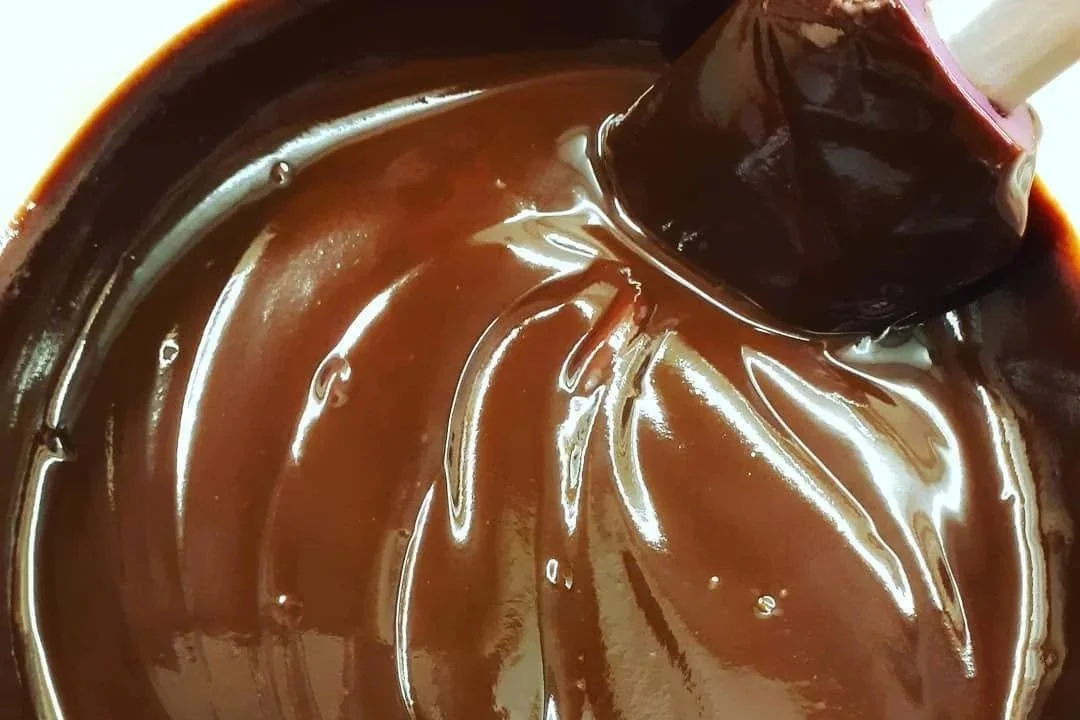
When I’m making a ganache, I’m likely to be working with a few hundred grams of chocolate in a small bowl, mixing it by hand and adjusting the flavour and texture as I go.
Sometimes that is actually more difficult than making a large quantity, because tiny amounts of cream or flavouring are much less forgiving. Last week I made a test batch of layered yuzu-flavoured chocolates for a
new collection but I wasn’t happy with the flavour balance of the finished chocolate. I adjusted the ratio of cream and the second batch got my seal of approval.
That approach carries through to most of my products. I can make a small quantity of something, test it, see how it behaves and change it next time if I’m not happy with it. Sometimes I may decide not to make it again at all. Recently I checked some lemon and pineapple fondants I had been testing for shelf life. They hadn’t kept their flavour well enough, so that was the end of those. They may have been technically usable, but if I’m not happy with how they taste, I’m not going to sell them.
Sometimes I’m asked which of my products I’d recommend. Well, all of them. Why would I sell something I don’t like?
Right Place, Right Chocolate
That same flexibility carries through into the way I fulfil orders.
If an order for a particular truffle selection comes in on Thursday night, I’ll prepare the ganaches on Friday. If another order for the same selection arrives on Sunday, I’ve already done that part of the work, so both orders can be dispatched on Monday.
Occasionally the timing works out even better. Yesterday, for example, I was enrobing fondant creams and had enough fondant for a spare box. Knowing they’re best sellers and wouldn’t sit around for long, I enrobed them all. By the time I sat down to pack them, another order had arrived for the spare box, and it was on its way within about three hours of being placed.
Of course, the timing can just as easily work against me. I can spend an entire morning working with dark chocolate, get everything finished, clean the equipment and put everything away, only for an order to arrive shortly afterwards for something I could easily have made while the chocolate was still tempered. If I’d seen the order an hour earlier, it could have gone into the same production run. Instead, I have to temper another batch and start again.
That’s one of the realities of very small-scale production. I’m not running continuous production lines or keeping large quantities of every product ready on a shelf. An order can arrive at exactly the right moment, or five minutes too late.
Fun-Sized Batch, Full-Sized Costs
Of course, working this way has a cost. Small doesn’t necessarily mean cheap, although people often assume it does because there’s less of it.
Heating equipment, tempering chocolate, cleaning bowls and tools, labelling and packing still all have to happen whether you make 24 chocolates or 2,000. And I don’t benefit from the economies of scale that larger producers get when buying ingredients. It’s often difficult to get professional ingredients that aren’t in industrial-sized vats. Plus there’s my time. I can’t just load a machine, press start and have row upon row of perfect chocolates emerge.
The Packaging Envy Rabbit Hole
The same lack of economies of scale shows up in packaging too.
I’ll make a trip to a posh chocolate shop, see the beautiful packaging, and disappear down the “I’m not good enough” rabbit hole for a while. However, very slick packaging often depends on standardisation: the same product, the same recipe, the same ingredients, produced in enough quantity to justify having large numbers of wrappers or boxes printed in advance.
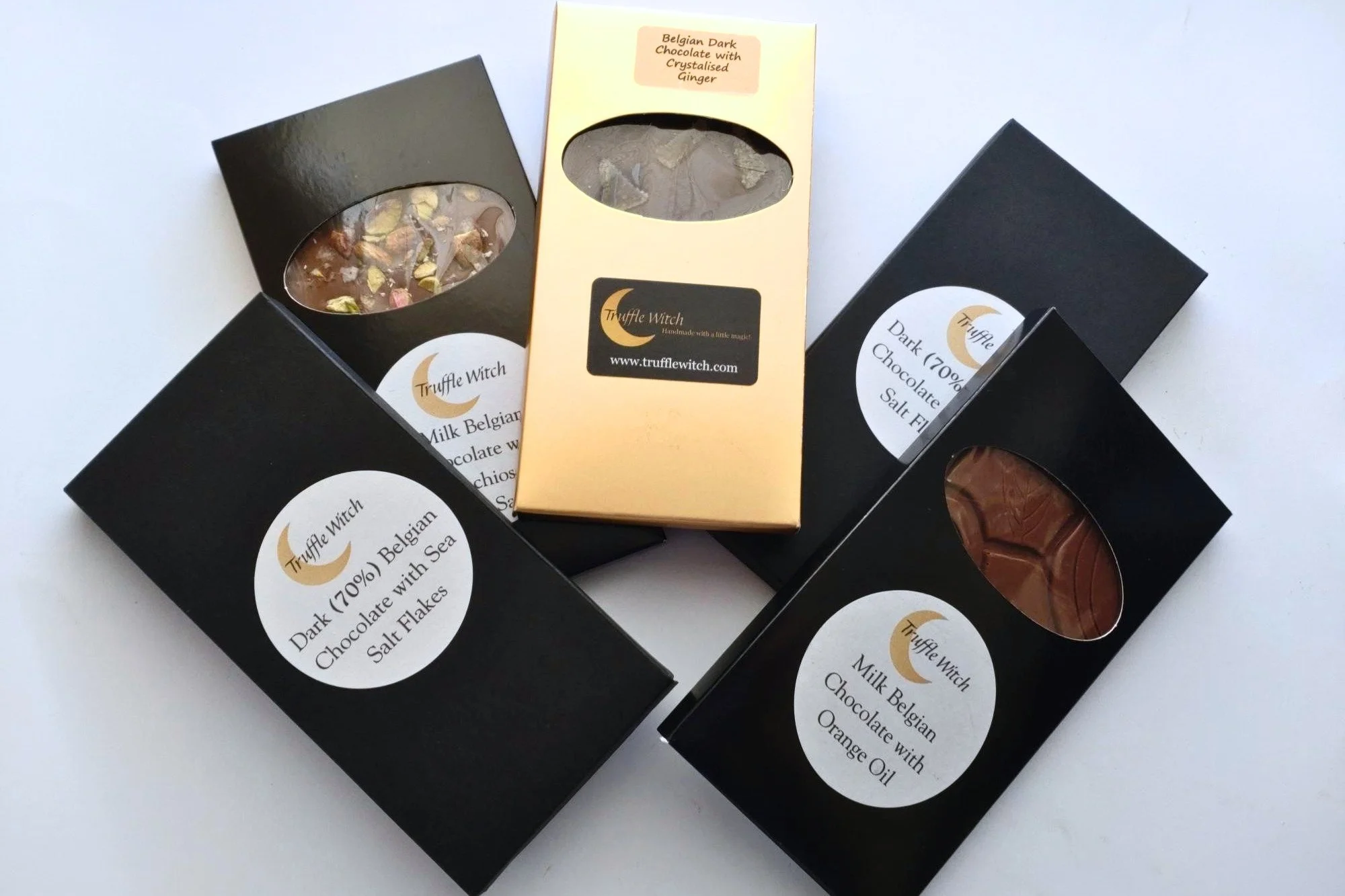
There’s no way that would make sense for a business like mine.
If you read my recent blog about disappearing ingredients, you’ll know they can change. Suppliers reformulate products. A particular couverture may suddenly contain something it didn’t before, or lose an ingredient it used to contain. A company can inconveniently stop making a key ingredient I’ve been
using for years. If I had hundreds or thousands of wrappers printed with a fixed ingredient list, they could become wrong overnight. To comply with legislation, the choice would then be to cover the information with a label or throw the packaging away. That could be a big wedge of money going in the bin.
Standardised packaging also removes my flexibility. If a particular flavour of truffle or chocolate bar falls out of favour with my customers — or I get bored with making it — I can just stop. At most, I’ll be throwing away a sheet of labels.
Having packaging that looks a little less polished than that of a much larger company is a fair trade-off for flexibility, economy and less waste.
Yes, I Really Did Make That
Ironically, even with all that visible evidence of being a very small producer, customers sometimes assume the opposite.
I’m often asked at events whether I’ve actually made everything myself. The chocolate shoes in particular seem to make people suspicious that I must have bought them in from somewhere. I suppose that says something about how blurred the word “handmade” has become. We’re used to seeing it on products made at considerable scale, while something genuinely made from scratch by one person can be mistaken for something factory-produced.
The Whole Production Team: Me
So what does “small handmade” mean in my case? It means genuinely small quantities, decisions made batch by batch, recipes changed when they need changing, and flexibility taking priority over perfect uniformity. The person choosing the ingredients, making the chocolates, checking the quality, packing and dispatching them, and sometimes selling them to you face to face across a table — is me.